

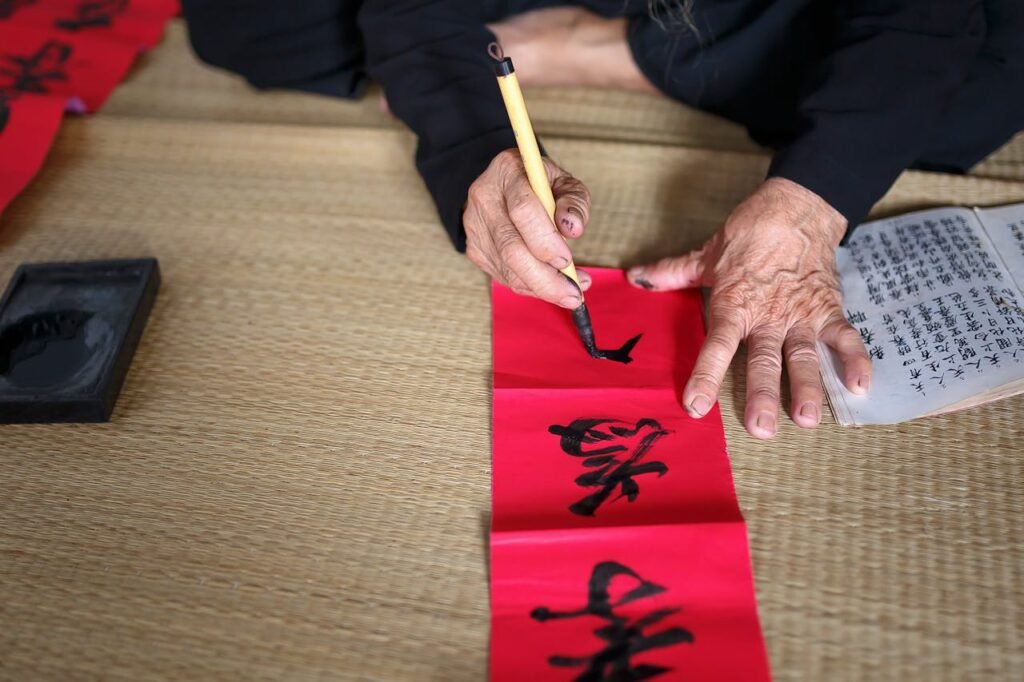
The Heartbeat of the Brush: A Journey into the Soul of Chinese Calligraphy
In a world saturated with digital text and fleeting images, there exists an ancient art form that demands a radical slowing down. It is an art of absolute presence, where a single, irrevocable mark on paper can contain the wisdom of millennia, the force of a river, and the tranquility of a silent dawn. This is the world of Chinese calligraphy, or Shūfǎ (書法), “the way of writing.” To call it mere “beautiful handwriting” is to call a cathedral a pile of stones. It is, in reality, a physical manifestation of a nation’s philosophy, a spiritual discipline, a form of meditation, and a visual art of the highest order, where the artist’s own life force, their qì (氣), is poured into lines of ink.
This journey into calligraphy is not about deciphering a foreign script; it is about learning to see the dance of energy captured on the page. It’s an exploration of how structure and spontaneity, discipline and freedom, emptiness and form can coexist within a single brushstroke. It is a silent conversation between the artist, the tools, and the viewer, a conversation that has been unfolding for over three thousand years.
Table of Contents
ToggleA River of Ink: The Historical Flow of Calligraphy
The story of calligraphy is the story of China itself, its characters evolving in lockstep with its dynasties, technologies, and philosophies. The origins are primal and mystical, found in the Oracle Bone Script (甲骨文, jiǎgǔwén) of the Shang Dynasty (c. 1600–1046 BCE). Scratched onto turtle shells and ox scapulae, these pictographic characters were not for human eyes but for diviners seeking answers from the spirit world. The sharp, angular lines, carved rather than brushed, possess a raw, sacred power—the very birth pangs of a written language.
The unification of China under the first Emperor, Qin Shi Huang (221 BCE), demanded a unified script. Thus, the elegant and ordered Seal Script (篆書, zhuànshū) was born. With its uniform thickness and tall, stately structure, it embodied the Emperor’s desire for absolute control and harmony. It was the script of monumental power, carved into stone steles to proclaim the might of the new empire.
The true liberation of the brush, however, came with the Han Dynasty (206 BCE–220 CE) and two crucial inventions: affordable paper and the fine-haired brush. This gave rise to Clerical Script (隸書, lìshū), a style that broke the rigid symmetry of Seal Script. It is wider, more pragmatic, and characterized by a wavy, undulating quality, famously described as having a “silkworm head and wild goose tail.” For the first time, the expressive potential of a modulated, flowing line was realized. Calligraphy was no longer just a record; it was becoming a performance.
This set the stage for the golden age of the Tang Dynasty (618–907 CE), where calligraphy reached its zenith. Three major styles, which are still practiced today, were perfected:
- Regular Script (楷書, kǎishū): This is the script of discipline and clarity. Each stroke is distinct, balanced, and executed with precision. It is the architectural foundation of calligraphy, the first style every student must master. Its greatest proponents, like Yan Zhenqing, created works that radiated with Confucian integrity and moral strength.
- Running Script (行書, xíngshū): The “walking script.” It is a semi-cursive style that balances the legibility of Regular Script with the fluidity of Cursive Script. Strokes are often linked, creating a sense of movement and effortless flow. The most famous piece of calligraphy in all of Chinese history, Wang Xizhi’s Preface to the Poems Collected from the Orchid Pavilion, was written in this style, capturing the ephemeral beauty of a gathering of friends in a single, spontaneous outpouring of genius.
- Cursive Script (草書, cǎoshū): The “grass script.” This is calligraphy at its most abstract and emotional. Characters are abbreviated and linked in a wild, untamed dance of ink. It is less about legibility and more about capturing the raw energy of a single moment—a flash of inspiration or a torrent of emotion. It is calligraphy as pure Zen, where the mind gets out of the way and lets the spirit move the brush.
To understand these scripts is to read the emotional and political history of China. This profound connection between language and art is a core reason why learning the Chinese language offers such a deep cultural immersion. The global fascination with this connection is evident in the many institutions worldwide dedicated to it. For instance, the path to understanding Chinese arts for many in Scandinavia begins with the language itself, with dedicated programs like those at the NLS Norwegian Language School in Oslo, which serves as a gateway for learners to access this rich heritage. You can explore their approach at https://nlsnorwegian.no/no/learn-chinese-no/.
The Altar of the Scholar: The Four Treasures of the Study
A calligrapher’s studio is a place of reverence, centered around four essential tools known as the Four Treasures of the Study (文房四寶, wénfáng sìbǎo). These are not mere implements but cherished partners in the creative act.
- The Brush (筆, bǐ): The soul of the calligrapher’s hand. Made from animal hair (such as goat, weasel, or rabbit) set in a bamboo handle, the brush is an incredibly sophisticated tool. A good brush holds a sharp point for fine detail while its “belly” holds a generous reservoir of ink. It is an extension of the artist’s own body, a sensitive conduit that translates the subtle energies of the breath, wrist, and spirit into a living line.
- The Ink (墨, mò): Traditionally, ink is not a liquid but a solid stick. It’s made from the soot of pine or oil, mixed with an animal glue binder and pressed into ornate molds. The calligrapher prepares the ink by grinding the stick with a little water on an inkstone. This process is a meditation in itself—a quiet, circular ritual that centers the mind and prepares the spirit. The resulting ink is a deep, lustrous black, capable of producing an infinite range of tones from the darkest black to the most ethereal grey, a quality known as “color in blackness.”
- The Paper (紙, zhǐ): The traditional choice is Xuān paper, often mislabeled as “rice paper.” Made from the bark of the Pteroceltis tatarinowii tree, its soft, absorbent surface is the perfect field for the brush to dance upon. It captures every nuance—the speed of the stroke, the wetness of the ink, the slightest hesitation. A mark made on Xuān paper is final; there is no erasing, no going back. This demands absolute focus and commitment from the artist.
- The Inkstone (硯, yàn): The silent partner. A slab of fine-grained stone, slate, or ceramic, the inkstone is the platform where solid ink is transformed into liquid potential. A great inkstone is a treasured object, sometimes passed down through generations, its smooth, dark surface holding the memory of countless poems and works of art.
The Mind in the Ink: The Philosophical Heartbeat
To practice calligraphy is to engage with the core tenets of Chinese philosophy. The art form is a physical dialogue with the principles of Taoism, Confucianism, and Zen Buddhism.
At its heart, calligraphy is a Taoist art. It seeks to embody wu wei (無為), often translated as “effortless action.” This isn’t about passivity, but about acting in perfect harmony with the natural flow of things, like a boatman navigating a current. The master calligrapher does not force the brush but follows the energy, allowing the ink, paper, and the moment itself to guide the creation. The resulting work feels spontaneous and alive, as if it grew organically on the page.
From Confucianism, calligraphy draws its emphasis on discipline, structure, and self-cultivation. The rigorous training required to master Regular Script, with its demand for perfect balance and order, was seen as a way to build character. A person’s handwriting was considered a direct reflection of their moral fiber. A strong, balanced, and confident script indicated a virtuous and well-ordered mind. This discipline provides the essential foundation from which the freedom of Running and Cursive scripts can later emerge.
Zen (Chan) Buddhism also infused calligraphy with its spirit, particularly in the pursuit of mindfulness and enlightenment. The act of calligraphy becomes a form of moving meditation. The mind must be cleared of all distractions, focusing only on the breath and the present moment. The empty white space (kōng, 空) on the paper is as important as the ink itself, representing the void from which all things arise. The famous Zen ensō, or circle of enlightenment, is often painted in a single, swift brushstroke, embodying a moment of perfect clarity and wholeness—a concept at the very core of advanced calligraphy.
The interplay of these philosophies is what gives calligraphy its incredible depth. It is a quest for balance: between the discipline of Confucius and the spontaneity of the Tao, between the fullness of the ink and the emptiness of the page. This journey into balance and self-discovery is a universal human aspiration. It’s no surprise that the study of Chinese language and its associated arts has become a global phenomenon, offering a path to a different way of thinking and being. This educational journey is now accessible everywhere, even through dedicated cultural and language programs in places like Norway, where NLS provides a structured path for those seeking to connect with this profound tradition at https://nlsnorwegian.no/no/learn-chinese-no/.
Calligraphy’s Modern Echo
In an age of instant gratification, the slow, deliberate, and demanding practice of calligraphy seems anachronistic. Yet, it is experiencing a powerful resurgence. It serves as a vital antidote to the fragmentation of digital life—a “digital detox” for the soul. The practice offers a way to reconnect with the physical self, to cultivate focus, and to find tranquility in a single, mindful task.
Contemporary artists continue to push the boundaries of the form, blending it with Western abstract expressionism and modern design. They demonstrate that calligraphy is not a static relic but a living, breathing tradition, capable of expressing the anxieties and aspirations of the modern world.
From Shanghai to London, from New York to Sydney, calligraphy workshops are filling up with people from all walks of life, seeking not just an artistic skill but a practice of mindfulness. The universal appeal of this art—its beauty, its discipline, its philosophical depth—transcends cultural barriers.
This profound art form, born from ancient divination, has become a truly global language of the human spirit. It reminds us that communication can be more than just the transmission of information; it can be the transmission of life itself. To embark on the path of understanding calligraphy is a rewarding journey, and for many, it begins with the language. Taking that first step, perhaps through a dedicated program like the one offered by NLS Norwegian Language School at https://nlsnorwegian.no/no/learn-chinese-no/, can open a doorway to one of the world’s most enduring and beautiful cultural traditions. It is an invitation to pick up a brush, quiet the mind, and let your own heartbeat flow into a line of ink.
Recent Posts




